Showing posts with label Bad Ass Women. Show all posts

Saturday, April 29, 2017

Bad Ass Women of History: Jacqueline Charlotte Dufresnoy


 Jacqueline Charlotte Dufresnoy was a French actress, singer, and activist. She was born Jacques Charles Dufresnoy in Paris in 1931. Using the stage name Coccinelle (French for ladybug), she was a transgender showgirl working at Chez Madame Arthur in 1953. She also performed regularly at Le Carrousel de Paris, a club which also featured April Ashley and Marie-Pier Ysser, two other prominent transgender performers.

She began to take hormones in 1952. In 1958, Dufresnoy underwent a vaginoplasty performed by Dr. Georges Burou, the first French person to undergo this operation. Upon her return to France, she became a media sensation but would continue her work as a performer and actress working on six films between 1959 and 1968. In 1963, she starred in the revue “Cherchez la Femme” at the Paris Olympia.

In 1960, she married a sports journalist, Francis Bonnet. This marriage set the legal precedent establishing transgender individual’s right to marry in France. It also made her the first transgender woman to be officially recognized by the French state according to her identified gender. She would marry two more times: Mario Costa in 1963, a Paraguayan dancer, and Thierry Wilson, a fellow transgender activist, in 1996.

In 1994, alongside Wilson, she launched the Association Devenir Femme (To Become Woman), a foundation designed to provide emotional and practical support for those seeking gender reassignment surgery. She also established the Center for Aid, Research, and Information for Transsexuality and Gender Identity. Jacqueline died as the result of a stroke in 2006.

There seems to be very little information about Dufresnoy’s life, but this is perhaps a reflection of the time in which she lived and not of her importance to the issue of transgender rights. She is an important figure, and her contributions cannot be underestimated. I think the reason that she is such a bad ass is because she lived authentically in her own truth. 

For every story like hers, there are a lot more of transgendered individuals who suffered in silence. We need to see these stories as equal to our own cis-gendered experiences. There are many speaking out for the rights of the transgender community to be able to live their lives like everyone else. We have beautiful women like Laverne Cox who isn’t afraid to be authentic and live her truth for all to see. I think that is the greatest message that any woman can learn. Be who you are and not who society tells you to be.

Monday, April 10, 2017

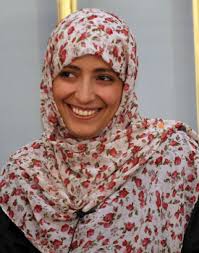
Bad Ass Women of History: Tawakkol Karman


Tawakkol Karman is a Yemeni journalist, politician, and human rights activist. In 2011, she became the first Arab woman to win the Nobel Peace Prize. She is a leader of the group “Women Journalists Without Chains” which she co-founded in 2005. 

She first rose to prominence in the Yemen in 2005 and then as an advocate for a mobile phone news service in 2007 which led to protests to gain freedom for the press.  Karman organized weekly protests in support of this effort. This is a woman who used her voice in a place where women’s voices were often silenced. 

As a human rights activist, she was vocal about the treatment of Yemeni women. Karman alleged that many Yemeni girls suffer from malnutrition and that two-thirds of Yemeni are unable to read. She also advocated for laws that would prevent females younger than 17 from being married.
Karman was greatly involved in the 2011 protests in Yemeni as part of the Arab Spring uprisings. She organized student rallies in Sana’a in protest against the long-standing rule of Saleh’s government. For her part, on January 22nd, she was arrested by three men in plains clothes without police identification, taken to prison, and held for 36 hours until she was released on parole. This did not deter her as she led a protest when she called for a “Day of Rage” on February 3rd similar to events that had taken place as part of the 2011 Egyptian revolution as well as the Tunisian revolution. She was re-arrested on March 17th amidst ongoing protests. 

Karman was not deterred and assailed the US and Saudi Arabia for their support of the “corrupt” Saleh regime in Yemen. She argued that American intervention in Yemen was motivated by the war on terror and was not responsive to the human rights abuses and calls from Yemen’s democracy movement as those in the Saleh regime could maintain a status quo. Karman further affirmed that it was not instability that the protesters were seeking but rather that they wanted stability in the region and country. 

Karman also lobbied the UN Security Council to not make a deal that would pardon Saleh but hold him accountable, freeze his assets, and support the protesters. The UN ultimately passed a resolution that condemned Saleh’s government for the use of deadly force against protesters while also backing the Gulf Cooperation Council’s initiative that gave Saleh immunity from prosecution for his crimes if he resigned. Karman criticized the vote and continued to advocate for Saleh to stand trial at the International Criminal Court. After meeting with Secretary of State Hilary Clinton, she was critical that Secretary Clinton’s response did not adequately demonstrate an appreciation on the part of the Obama administration for the sacrifice of the Yemeni people.

In 2011, she was honored along with Ellen Johnson Sirleaf and Leymah Gbowee with the Nobel Peace Prize for “their non-violent struggle for the safety of women and for women’s rights to full participation in peace-building work.” Karman recognized the significance of her award as only the second Muslim woman and the first Arab woman to receive the prize. At the time, she was also the youngest recipient until 2014 when it would be given to Malala Yousafzai. 


Karman has continued her work traveling to Qatar where she met with Sheik Tamim bin Hamad Al Thani and requested assistance from the Doh Centre for Media Freedom in establishing a television and radio station, Bilqis, named in honor of the Queen of Sheba, to support female journalists and broadly educate Yemeni journalists. She also speaks at colleges and universities across the globe to discuss women, human rights, and the Arab Revolution.